Tag: standing with survivors

  • The Importance of Never Outgrowing Wonder

    The Importance of Never Outgrowing Wonder

    When I was a kid, I walked a dirt road to the school bus stop each morning with my mom and my sister.

    One morning, I kicked a rusty can along the roadside while my mom and sister walked hand-in-hand behind me. Suddenly, Mom called out, “Susan, watch out!”

    I jumped back.

    She pointed to the ground.

    “Don’t step on those, honey! Those are fairy caps.”

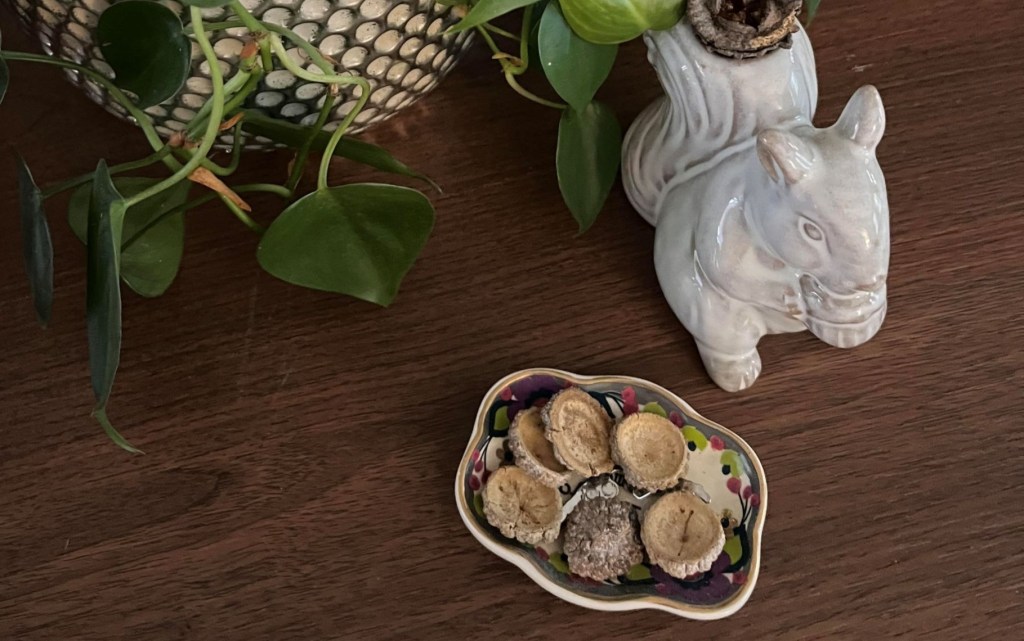
    I looked down. Acorns covered the roadside. Some still wore their little caps. Others had lost them.

    Mom was right. They were exactly the right size for fairies.

    “Where are the fairies?” I asked.

    “They live over there, and sometimes they fly so fast that their hats fall off,” she said, pointing at the woods that fringed this dusty road, and continued walking.

    I slipped a fairy cap into my pocket and hurried to catch up.

    For years afterward, those tiny acorn caps became treasures. They inspired adventures in the woods, stories, and hours of imaginative play.

    Looking back, I realize my mom was giving me a gift that had very little to do with fairies. She was teaching me to see the world with wonder, perhaps without even knowing it.

    As my daughters were growing up, I shared the story of the fairy caps with them. Happily, they seemed to embrace the magic with me! We collected them on walks and tucked them into our pockets.

    Today, my girls are grown women. But every now and then, one of them will hand me a tiny acorn cap she found along a trail, a smile and sparkle in her eyes.

    No explanation needed. We both know exactly what it means.

    A small piece of childhood wonder has survived another generation.

    Recently, I ordered two books I have wanted to read. One is by Donald Winnicott, who wrote extensively about children, play, and emotional development. The other is Walden by Henry David Thoreau, a classic I somehow never got around to reading.

    When I clicked “Place Order,” I felt excited.

    The same thing happens when I wander through the library in Georgetown, DC, a favorite pastime. I never know what treasure might be waiting on a shelf. I love history, and this library is filled to the brim with it. 

    I felt it when I began writing my own stories and certainly when I published my first solo book.

    I feel it each time a new book launches into the world.

    There is something hopeful about opening a book for the first time. A sense that somewhere inside those pages may be a new idea, a new understanding, or a new hero.

    At nearly eighty years old, I still feel that excitement. And I’ve decided that’s a very good thing.

    As we grow older, it’s easy to believe that wonder belongs to children. We become busy. Practical. Responsible. We focus on obligations, schedules, and the endless stream of troubling news from the world around us.

    Yet I wonder if curiosity and imagination remain just as important in later life as they were in childhood. They sure are for me.

    Wonder invites us to keep learning. Curiosity encourages us to ask questions. Imagination helps us see possibilities where others see only limitations.

    Wonder reminds us that there is always more to discover.

    I think that’s one reason I enjoy spending time with children. They haven’t forgotten how to be amazed. A cardboard box becomes a playhouse. A pine tree becomes a secret fort. An acorn cap becomes evidence that fairies have passed by.

    The beautiful thing is that we don’t have to leave that way of seeing things entirely behind.

    We can still pause to notice a bird at the feeder or a squirrel up to mischief.

    We can still delight in learning something new.

    We can still carry a few fairy caps home in our pockets.

    The world can be hard at times. We all know that.

    But wonder keeps a small window open to beauty, possibility, and joy.

    I believe growing older does not require us to outgrow wonder. Maybe it’s asking us to protect it.

    And if I happen to spot a fairy cap along the path, you can count on it that I will probably pick it up.
  • Resilience Rests in Relationships

    Resilience Rests in Relationships

    It was a particularly steamy day at the rescue center in Cambodia, and the team was tired. Serving more than one hundred children each day drained us in ways we hadn’t anticipated. Thankfully, our talented craft designer had come up with a winner.

    The project was a pillow made from soft, colorful fleece. Simple enough: two squares placed together, thick fringes cut around the edges. The children’s job was to tie the matching fringes into knots and then stuff the pillow with polyester fiberfill.

    This was, by far, one of the most popular crafts we ever offered. Having seen where many of the children lived—and how they lived—it was easy to understand why. A pillow was not a given. It was a luxury. The older children quickly began teaching the younger ones, and for a moment, the room felt light.

    No, wait.

    The younger children couldn’t tie knots.

    We adjusted quickly. We formed circles—one team member, a couple of teenagers, and a handful of little ones in each group. The older kids helped the little ones tie the fringes and stuff the pillows. Laughter returned. Soon the pillows were finished, and that’s when the magic began.

    Some of the older children clutched their pillows to their chests and slipped away from the noise, stretching out quietly on the floor and resting their heads on their new cushions. Others began batting each other with their pillows, collapsing into giggles. As long as the laughter stayed joyful, we let it continue. And some of the youngest simply held their pillows close, pressing them against their hearts as if holding something fragile and sacred.

    Then came one of the most tender moments I witnessed in Cambodia.

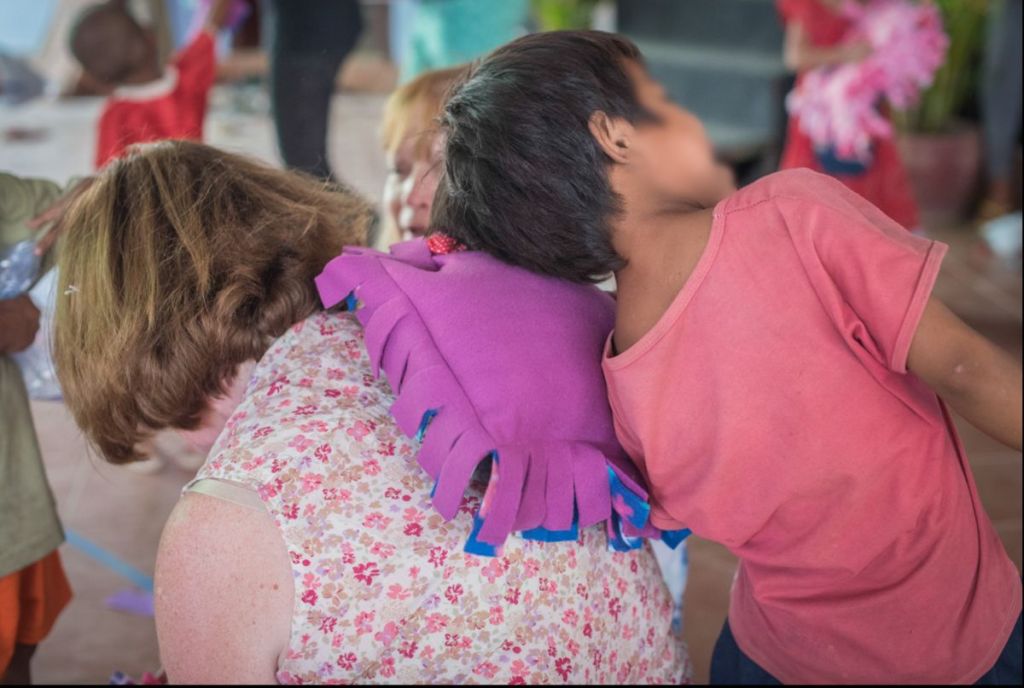
    Our craft leader sat on the floor, knees drawn up, head resting on her folded arms. With a gentle pat on her own shoulder, she motioned to a little girl nearby, inviting her to rest. Smiling in quiet understanding, the child placed her pillow across my teammate’s back and lay her head down. She closed her eyes. For several long minutes, she remained there—safe, still, trusting.

    At the time, we called what we were seeing resilience—breathtaking resilience. These children seemed affectionate, adaptable, and open. They leaned into us easily. They trusted quickly.

    But many of these children had endured things no child should face—abuse, abandonment, hunger, fear. And yet here they were, resting their heads on the back of someone they had known for only a few days.

    Was this resilience?

    Or was it a nervous system exquisitely trained to detect safety—and move toward it immediately?

    When I later discussed this with a psychotherapist, I learned that such responses are often complex. Some of what we saw may indeed have been genuine relief—the natural playfulness and attachment capacity that children carry within them. But some behaviors may also reflect trauma adaptations, especially what is commonly called the “fawn response”—a survival strategy developed early to appease an abuser and stay safe.

    One of the realities of trauma is this: when a child transitions into safety, their survival responses do not simply switch off. The body remembers.

    That day, I realized that what I had called resilience might be something far more complex — and far more fragile.

    I keep returning to the image of that little girl resting across my teammate’s back. Her face had softened. Her breathing slowed. For a few minutes, she was simply a child at rest.

    Was that resilience?

    Or was it something even more remarkable — a body that had learned, through experience, how to detect safety quickly and lean into it while it lasted?

    In only a matter of days, she trusted enough to close her eyes. To release her weight. To be still.

    Children who grow up in chaos often become exquisitely attuned to shifts in tone, posture, and invitation. They read rooms faster than adults. They soften when it is wise to soften. They attach when attachment feels safe enough.

    That is not weakness. It is brilliance.

    But brilliance born of survival is not the same as resilience born of security.

    What I once called resilience may have been something even more extraordinary — a nervous system that had learned how to survive.

    And I am no longer so quick to label.

    I am not an expert in child development. I am learning. And the more I learn, the more careful I become with my words.

    Developmental psychologist Ann Masten, often called the “queen of resilience research,” describes resilience as “ordinary magic.” She explains that resilience grows not from heroic inner strength alone, but from ordinary, dependable systems — safe relationships, steady caregivers, predictable environments. In other words, resilience flourishes in the presence of safety.

    That day in Cambodia, I began to understand the difference. What I witnessed may not have been fully formed resilience. It may have been the beginning of it — a child responding to safety in the moment.

    Perhaps that is where resilience truly begins.

    Since those days spent at the rescue facility, I have tried to move more slowly when working with children who have survived trauma, and with survivors I have met more recently. I no longer assume I understand what I am seeing. What looks like resilience may be adaptation. What looks like trust may be vigilance softening for a moment.

    I gently encourage volunteers and caregivers to remember that we are often witnessing only a sliver of a child’s story. Our role is not to diagnose or label, but to provide consistent safety and steady presence. And when deeper wounds surface — as they sometimes do — that is the time to step aside and invite trained professionals to guide the healing.

    Children deserve more than our admiration for their “strength.” They deserve environments where resilience can grow slowly, securely, and without the need for survival brilliance.

    Perhaps the most responsible posture we can take is this: stay curious, stay humble, and when in doubt, call in the experts.