It was a particularly steamy day at the rescue center in Cambodia, and the team was tired. Serving more than one hundred children each day drained us in ways we hadn’t anticipated. Thankfully, our talented craft designer had come up with a winner.
The project was a pillow made from soft, colorful fleece. Simple enough: two squares placed together, thick fringes cut around the edges. The children’s job was to tie the matching fringes into knots and then stuff the pillow with polyester fiberfill.
This was, by far, one of the most popular crafts we ever offered. Having seen where many of the children lived—and how they lived—it was easy to understand why. A pillow was not a given. It was a luxury. The older children quickly began teaching the younger ones, and for a moment, the room felt light.
No, wait.
The younger children couldn’t tie knots.
We adjusted quickly. We formed circles—one team member, a couple of teenagers, and a handful of little ones in each group. The older kids helped the little ones tie the fringes and stuff the pillows. Laughter returned. Soon the pillows were finished, and that’s when the magic began.
Some of the older children clutched their pillows to their chests and slipped away from the noise, stretching out quietly on the floor and resting their heads on their new cushions. Others began batting each other with their pillows, collapsing into giggles. As long as the laughter stayed joyful, we let it continue. And some of the youngest simply held their pillows close, pressing them against their hearts as if holding something fragile and sacred.
Then came one of the most tender moments I witnessed in Cambodia.
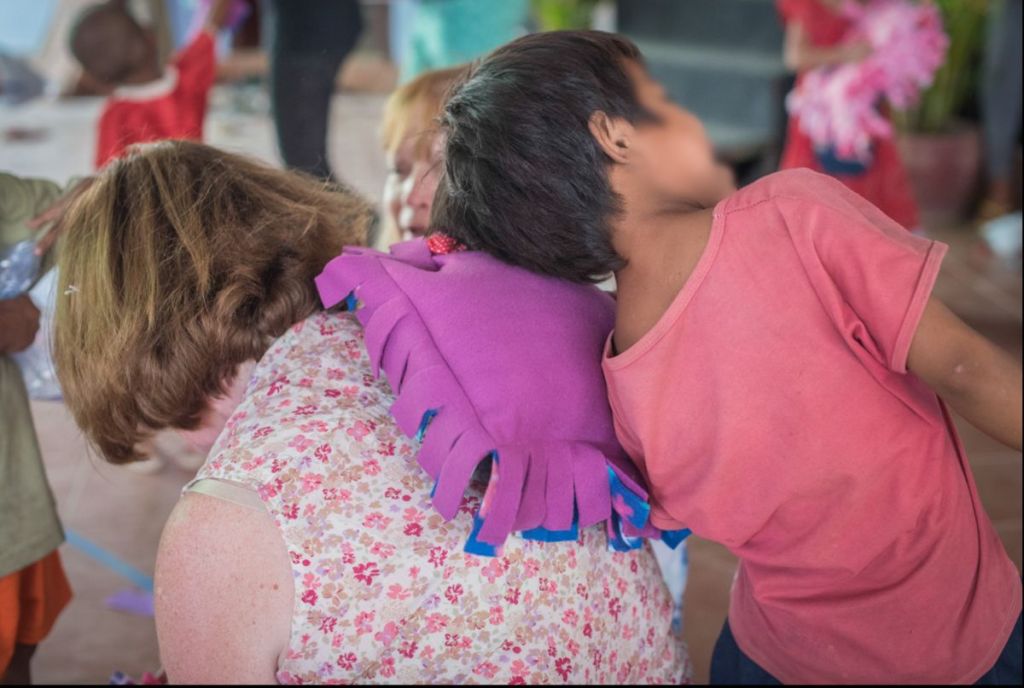
Our craft leader sat on the floor, knees drawn up, head resting on her folded arms. With a gentle pat on her own shoulder, she motioned to a little girl nearby, inviting her to rest. Smiling in quiet understanding, the child placed her pillow across my teammate’s back and lay her head down. She closed her eyes. For several long minutes, she remained there—safe, still, trusting.
At the time, we called what we were seeing resilience—breathtaking resilience. These children seemed affectionate, adaptable, and open. They leaned into us easily. They trusted quickly.
But many of these children had endured things no child should face—abuse, abandonment, hunger, fear. And yet here they were, resting their heads on the back of someone they had known for only a few days.
Was this resilience?
Or was it a nervous system exquisitely trained to detect safety—and move toward it immediately?
When I later discussed this with a psychotherapist, I learned that such responses are often complex. Some of what we saw may indeed have been genuine relief—the natural playfulness and attachment capacity that children carry within them. But some behaviors may also reflect trauma adaptations, especially what is commonly called the “fawn response”—a survival strategy developed early to appease an abuser and stay safe.
One of the realities of trauma is this: when a child transitions into safety, their survival responses do not simply switch off. The body remembers.
That day, I realized that what I had called resilience might be something far more complex — and far more fragile.
I keep returning to the image of that little girl resting across my teammate’s back. Her face had softened. Her breathing slowed. For a few minutes, she was simply a child at rest.
Was that resilience?
Or was it something even more remarkable — a body that had learned, through experience, how to detect safety quickly and lean into it while it lasted?
In only a matter of days, she trusted enough to close her eyes. To release her weight. To be still.
Children who grow up in chaos often become exquisitely attuned to shifts in tone, posture, and invitation. They read rooms faster than adults. They soften when it is wise to soften. They attach when attachment feels safe enough.
That is not weakness. It is brilliance.
But brilliance born of survival is not the same as resilience born of security.
What I once called resilience may have been something even more extraordinary — a nervous system that had learned how to survive.
And I am no longer so quick to label.
I am not an expert in child development. I am learning. And the more I learn, the more careful I become with my words.
Developmental psychologist Ann Masten, often called the “queen of resilience research,” describes resilience as “ordinary magic.” She explains that resilience grows not from heroic inner strength alone, but from ordinary, dependable systems — safe relationships, steady caregivers, predictable environments. In other words, resilience flourishes in the presence of safety.
That day in Cambodia, I began to understand the difference. What I witnessed may not have been fully formed resilience. It may have been the beginning of it — a child responding to safety in the moment.
Perhaps that is where resilience truly begins.
Since those days spent at the rescue facility, I have tried to move more slowly when working with children who have survived trauma, and with survivors I have met more recently. I no longer assume I understand what I am seeing. What looks like resilience may be adaptation. What looks like trust may be vigilance softening for a moment.
I gently encourage volunteers and caregivers to remember that we are often witnessing only a sliver of a child’s story. Our role is not to diagnose or label, but to provide consistent safety and steady presence. And when deeper wounds surface — as they sometimes do — that is the time to step aside and invite trained professionals to guide the healing.
Children deserve more than our admiration for their “strength.” They deserve environments where resilience can grow slowly, securely, and without the need for survival brilliance.
Perhaps the most responsible posture we can take is this: stay curious, stay humble, and when in doubt, call in the experts.


 For the Sake of Children
Leave a comment